Placebos are used in randomised control trials to limit the potential for any bias.
Blind controls as used in cases where subjects do not know if they belong to the placebo group or not.
Double blind controls happen where neither the subject being tested or the investigators are aware wh his in the placebo group.
Tuesday, 2 May 2017

Case control and cohort studies
What are case control studies and cohort studies?
What does this mean in clinical nutrition?
Case control studies are observational studies in which two existing groups (differing in outcome) are identified and compared on the basis of a casual attribute.
Group 1 - Has the condition or disease plus another factor.
Group 2 - Does not have the disease but has the same factor.
Cohort studies uses a group of people who share a common defining characteristic such as graduation or birth etc.
An analysis over time of risk factors of people who do not have a disease but uses correlations to determine the absolute risk.

What does this mean in clinical nutrition?
Case control studies are observational studies in which two existing groups (differing in outcome) are identified and compared on the basis of a casual attribute.
Group 1 - Has the condition or disease plus another factor.
Group 2 - Does not have the disease but has the same factor.
Cohort studies uses a group of people who share a common defining characteristic such as graduation or birth etc.
An analysis over time of risk factors of people who do not have a disease but uses correlations to determine the absolute risk.

What is Scientific bias?
Scientific bias is a systematic error. It gives an association that is not true.
In nutrition there are 5 main types of bias which can be found within studies:
Measurement bias - Poorly measured or improperly measured tests. Such as machines not been correctly calibrated for example.
Interviewer Bias - The outcome of the results is shaped by the belief of the interviewer. For example, should the interviewer feel there would be a benefit from the test, they will impress upon the subject their own bias.
Selection bias - Proper randomisation of subjects is not achieved.
Social acceptability bias - Survey respondents will answer questions in a manner which will be viewed favourably by others. Some people change their habits to encourage a better view of themselves. If there was an exercise questionnaire, subjects may be inclined to increase their exercise for better opinions of themselves.
Recall bias - Inaccurate recollections by study participants. It is not always easy to remember. IF subjects were asked to write down what the had eaten earlier in the day, they might well not remember.
In nutrition there are 5 main types of bias which can be found within studies:
Measurement bias - Poorly measured or improperly measured tests. Such as machines not been correctly calibrated for example.
Interviewer Bias - The outcome of the results is shaped by the belief of the interviewer. For example, should the interviewer feel there would be a benefit from the test, they will impress upon the subject their own bias.
Selection bias - Proper randomisation of subjects is not achieved.
Social acceptability bias - Survey respondents will answer questions in a manner which will be viewed favourably by others. Some people change their habits to encourage a better view of themselves. If there was an exercise questionnaire, subjects may be inclined to increase their exercise for better opinions of themselves.
Recall bias - Inaccurate recollections by study participants. It is not always easy to remember. IF subjects were asked to write down what the had eaten earlier in the day, they might well not remember.
 |
| Bias Mind map. |
Epidemiology and exam help
Epidemiology - this is the one I felt would be common sense. I felt this would be simple and straight forward.
No.
Not so.
Yikes.
To help me revise (no, hang on, to learn) I am going to try writing blog posts. Pray to God this will help you guys too. Let me know if it helps any of you...so, ok, here we go.
Epidemiology is 'the study of the occurrence and distribution of health related events, stats and processed in specified populations, including the study of determinates influencing such precesses and the application of this knowledge to control relevant health problems.' (Porto M. A dictionary of Epidemiology)
Distribution means the frequency and pattern of health events in a population.
Population is a group of people with a common characteristic.
Determinants are factors or events that influence health.
Epidemiology is a tool used by governments to determine investigations into public health.
Common terms used are
Sporadic - a disease which occurs occasionally and often irregularly
Endemic - Constant presence of disease within a given population.
Epidemic - above the expected level of occurrence of disease
Pandemic - an epidemic weidspread over several countries or continents.
Morbidity: any departure from a state of physiological or physiological well being.
Mortality: a number of reported deaths in a population in a specific time period.
Analytical Epidemiology - Basic question - "Is exposure and disease linked?"
Research questions/hypothesis - Do persons with exposure have higher levels of disease than persons without exposure?
3 major factors in epidemiology:
social factors
lifestyle factors
personal characteristics
Measure of disease frequency: Incidence = number of new cases of disease the developed during a specified period of time.
Prevalence - number of existing cases of disease at a given point of time or during a period of time.
I hope some of this may have helped, the next few blog posts go into specifics of exam questions you may find help you to revise! Good luck.
No.
Not so.
Yikes.
To help me revise (no, hang on, to learn) I am going to try writing blog posts. Pray to God this will help you guys too. Let me know if it helps any of you...so, ok, here we go.
Epidemiology is 'the study of the occurrence and distribution of health related events, stats and processed in specified populations, including the study of determinates influencing such precesses and the application of this knowledge to control relevant health problems.' (Porto M. A dictionary of Epidemiology)
Distribution means the frequency and pattern of health events in a population.
Population is a group of people with a common characteristic.
Determinants are factors or events that influence health.
Epidemiology is a tool used by governments to determine investigations into public health.
Common terms used are
Sporadic - a disease which occurs occasionally and often irregularly
Endemic - Constant presence of disease within a given population.
Epidemic - above the expected level of occurrence of disease
Pandemic - an epidemic weidspread over several countries or continents.
Morbidity: any departure from a state of physiological or physiological well being.
Mortality: a number of reported deaths in a population in a specific time period.
Analytical Epidemiology - Basic question - "Is exposure and disease linked?"
Research questions/hypothesis - Do persons with exposure have higher levels of disease than persons without exposure?
3 major factors in epidemiology:
social factors
lifestyle factors
personal characteristics
Measure of disease frequency: Incidence = number of new cases of disease the developed during a specified period of time.
Prevalence - number of existing cases of disease at a given point of time or during a period of time.
I hope some of this may have helped, the next few blog posts go into specifics of exam questions you may find help you to revise! Good luck.
Sunday, 26 March 2017
Waking up too early on Mothers Day
Mothers Day is here once again.
With my mother still here to grace us with her presence, yet my mother in law about to have her final curtains drawn on life, I can't help but wonder what is it all about. Then I remember, I know now.
Wisdom.
Age.
Time.
They have all taught me exactly what I should be doing with this thing called life. I should be chasing memories and creating JOY. And I know what that means for me and where it takes me.
To the woods, the trees, the nature.

With my mother still here to grace us with her presence, yet my mother in law about to have her final curtains drawn on life, I can't help but wonder what is it all about. Then I remember, I know now.
Wisdom.
Age.
Time.
They have all taught me exactly what I should be doing with this thing called life. I should be chasing memories and creating JOY. And I know what that means for me and where it takes me.
To the woods, the trees, the nature.

As a family, we are beginning to rethink things. We want to be in the woods and grow organic vegetables, breathe good air and the like.
What wakes me so early? Is it excitement? Stress? Thinking? Physical health? I'm really not sure.
Exams and deadlines loom all around, I feel flutters within my heart. They frighten me. Apparently, that coupled with the memory loss I keep experiencing and the lack of sleep all come up with anxiety, depression and stress (when you use Google).
My old friend from London Met used to say "I like the Google very much." In her strong adorable indian accent. I miss her.
So mothers day brings me to a place of once again being at my desk, writing (I can't get enough of it) and wanting to do more and more and more all of the time. There's so much there's too much.
Project proposal looms. I'm going to love that yet I'm unclear where to start. Watch this space, I will give you more detail and information as I can.
Meanwhile, back to looking for sellotape to wrap mums gift. That eludes me.
Monday, 9 January 2017
Philip Bloom, Digital Creator
Meeting Philip Bloom was an honour and a pleasure yesterday.
As head cameraman of Sky news, you might be forgiven for wondering what this may have to do with science, relevant enough to add a piece of writing about it here on my pebblepad.
Heading to the Youtube space in the Google offices in London was pretty much a little dream come true. Initially, I headed there to accompany my daughter who is at college studying creative media. Yet with a passion for the science of nutrition, creativity and business all rolled into one, I figured there is likely to be times when creation of a digital nature would be exciting to use.
The dream of encouraging nations to eat better, with a clear guide of why and how it will benefit them and their lives is real. The wonderful world wide web gives us this amazing platform to share our scientific findings.
Mr Bloom, the award winning photographer gave an amazing speech in London last night. I was taking mental notes on his presentation skills, something super important in this years course. When he began talking of taking the transition of shooting from DSLR camera to video camera, I did get a little lost in the nomenclature of all the different models of camera available, just as likely as the audience may have been confused on the nomenclature of a periodic table.
Nonetheless, this evening gave me a wonderful insight into what life can be like in this diverse world of digital. Should my youtube channel get a wide enough audience to build on the 1000 subscribers I already have and head up to 10,000 then Google and Youtube extend an arm of generosity as they open up their studios for filming and their offices for writing. Of course there is no lab in sight but I think that may be taking things one step too far with the general population. So, now there is an inspired dream inside to continue with these studies enough to confidently make some educational laymens term videos to help spread the word of health into the nation who has ears to listen.
Plus, there is a free barister on weekdays!
Presentation skills workshop
Attending a presentation skills workshop seemed a no brainer when the invite arrived in my inbox via the employability office.
Many times we have been encouraged as a class to get used to the idea that we would be presenting many times over. At my last university, in year Zero, I was fortunate enough to be encouraged to speak at many of their events which were well attended by industry experts.
Most of us felt as though this was more of a practice as opposed to learning workshop, which was fine, yet I did feel I would have loved to go further into detail. Perhaps as a mature student with experiences already I was expecting too much. As a note to myself, I wondered how I should be learning more about my presenting skills. Perhaps this is something I could look further into very soon. I know there will be many videos on the internet helping with the finer details of making a good presentation.
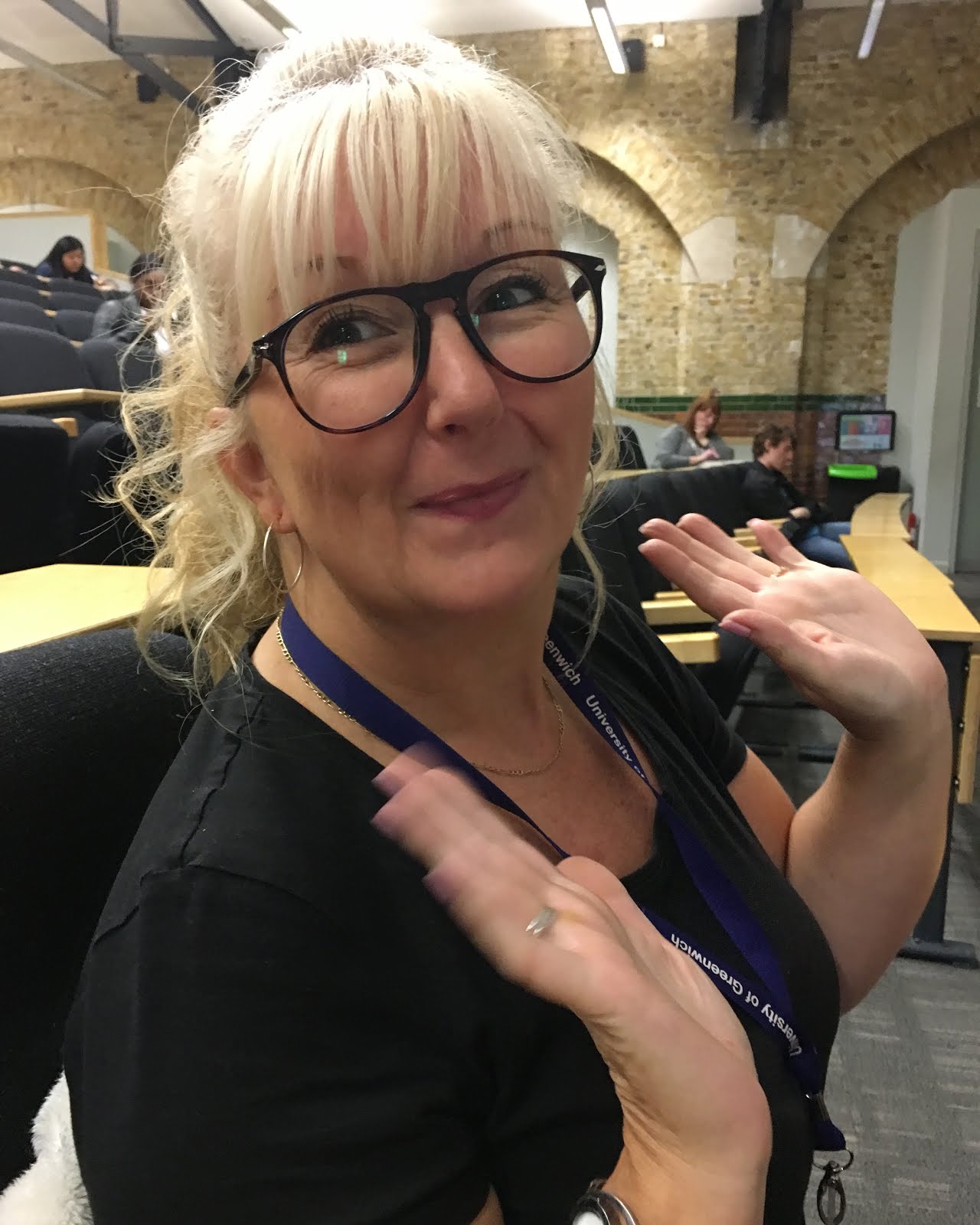
Nevertheless, this was not a waste of time as I met a couple of new students who I could now smile and wave at on campus, as well as fulfilling a requirement of attendance towards my own course credits.
Win/win.
Subscribe to:
Posts (Atom)